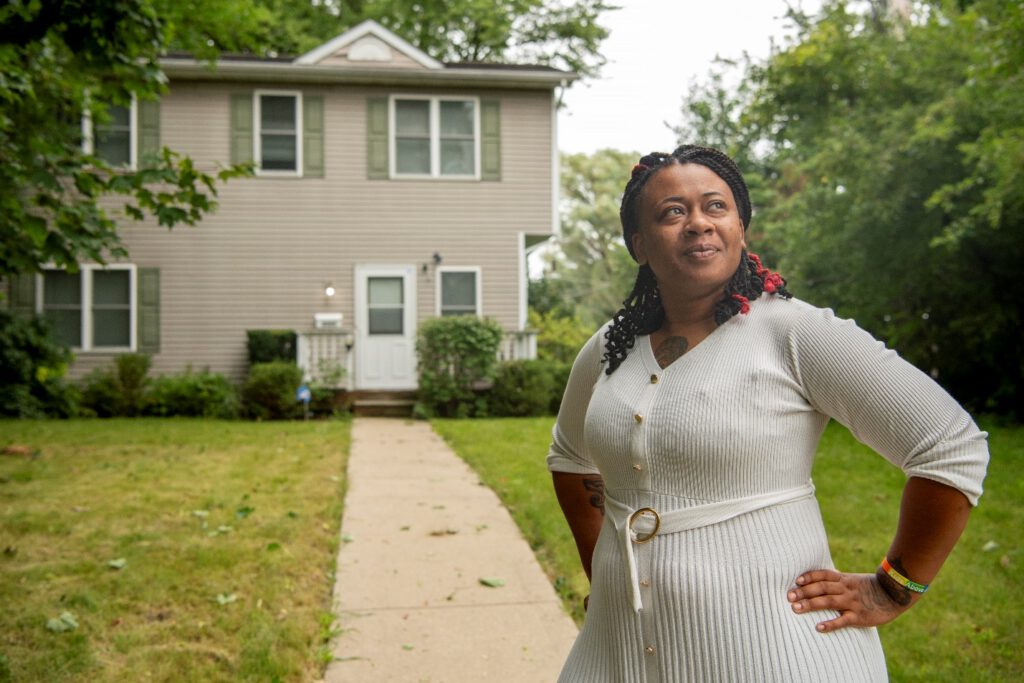

Ashley was a single mom working odd jobs to make ends meet. When she learned about Catholic Charities’ Family Self-Sufficiency Program, she was nervous about the five-year commitment. But, knowing it could help put her life on a path to long-term stability, she decided to take the risk.
It wasn’t an easy journey, and she didn’t always think she was going to make it through the program. But she says her team at Catholic Charities walked alongside her the whole way, believing in her when she didn’t always believe in herself. This empowered her to keep going. She set goals and achieved things she once only dreamed of. Today, she is building up her savings. She is living in a house where she and her children each have a bedroom of their own. She has a job as a school bus driver that makes her happy.
“I’m grateful,” Ashley says. “I’m really proud of what I did.”
Uplifting and empowering single moms
Last year, 330 people like Ashley participated in Catholic Charities Family Self-Sufficiency Program, which has been empowering families with single heads of household to overcome obstacles and achieve goals since 1984. Most participants are single mothers in their 30s ready to make the long-term commitment to build self-sufficiency while transitioning off of government assistance.
“The work is really done by the individual in the program,” says Patti Fuller, the program’s former manager in Lake County. “But a lot of times, it takes that gentle nudging and the support of a case manager to lift somebody up and develop those skills of advocating for their children and themselves. We recognize and see those successes in our participants.”
The program, funded by the Illinois Department of Human Services, connects participants with housing and employment resources, food and emergency assistance, and pregnancy and parenting support. Staff and participants meet monthly for up to five years. In addition to professional guidance, assistance with planning budgets and managing finances, and help finding and maintaining housing, staff uplift and encourage participants.
Setting and achieving goals
“My case managers would ask me, ‘What are your goals? What do you want to do?’” says Ashley, who joined the program in 2015 when she and her two children were living in low-income housing. “For me, I’m like: ‘Breathe. Make it to the next day. I don’t have goals.’
“They helped me establish goals,” Ashley adds.
With support from her case manager, Ashley got her Permanent Employee Registration Card which allowed her to start working in security and building her savings. Beyond professional development, she received emotional support when she was going through a difficult divorce with a new baby.
“They came right along with me,” Ashley says. “Going through all those changes, feeling hopeless, feeling helpless—they were there.”
“It’s like magic.”
Ashley made strides, experienced a few setbacks, was stalled by the pandemic but was granted a program extension, which helped her land where she is today, meeting financial, professional, and personal goals. Having earned a Class B CDLS license, Ashley accepted a position last year as a local school bus driver. One of her goals was to get her credit in order so she could become a first-time homeowner by the age of 35. She is well on her way, having secured a housing voucher to rent a three-bedroom, two-bathroom house.
“I cried the first day when they told me I could move in,” Ashley says. “We have a backyard, and I have a firepit now. My son has a basketball rim. I’m able to have a barbecue grill. I have a garage.
“I can actually breathe. I have space.”
Ashley’s experience with Catholic Charities and the constant support she received from her team along the way makes her want to give back now, as a graduate of the program.
“When you see that you can actually get that kind of help, it’s like magic,” she says. “Who can I help to do the same things that I’ve done?”