
Case Manager April Nickson has worked with military veterans at Catholic Charities of the Archdiocese of Chicago’s St. Leo Residence for Veterans for 15 years. She’s witnessed veterans who have moved in and never slept in their bed; instead, they sleep on the floor because that’s been their routine and what they know. April says she’s known a lot of veterans who joined the military to escape their home life, and others who suffered a traumatic experience in the military. Once they are discharged, she says, many veterans find life isn’t what they expected it would be.
“If they experienced trauma, they’re no longer the people they used to be,” she says. Some turn to crime and drugs. Others may struggle to recognize or deal with mental illness. “They internalize it.”
Struggling to cope, often with mental and physical health conditions, substance use issues, and job instability, a disproportionate number of veterans—about 7% of the overall homeless population in the U.S.—end up without a permanent place to live.
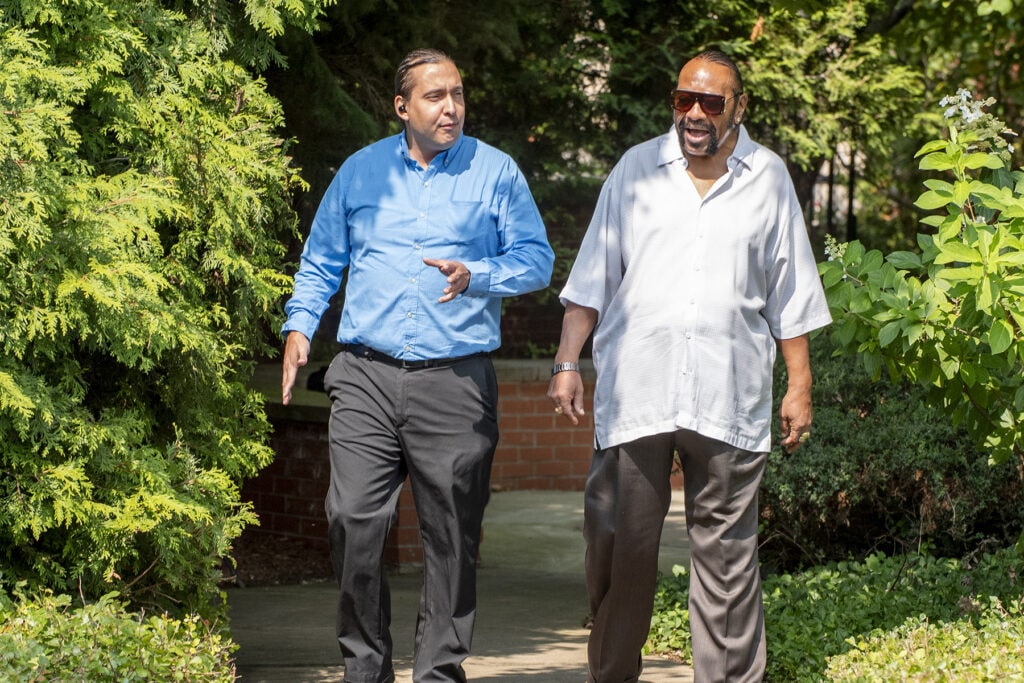
“Sometimes people just need someone to listen and be present and not ever sit in judgment,” says David Dempsey, Program Director for St. Leo Residence for Veterans.
That’s what David, April, and the Catholic Charities team at St. Leo provide: a listening ear, a caring presence, and courageous compassion for the veterans they work with.
Access to vital support for veterans
More than 130 previously homeless veterans now live at St. Leo. The facility opened on Chicago’s south side in 2007 to serve chronically homeless, low-income veterans who have a disability.
Funded by the U.S. Department of Housing and Urban Development, this permanent supportive housing program operates under the Housing First model, which removes all barriers to housing someone who was previously homeless. Nearly half of the residents in St. Leo’s furnished studio apartments have lived there for five years, and 95% of residents are Black males.
When Dan was honorably discharged from the U.S. Navy after suffering a leg injury during Desert Storm/Desert Shield, he returned home to Chicago. He found work, but when his son suddenly died of an asthma attack at age 3, Dan fell into a deep depression. He lost his job and soon found himself without a place to live.
“But I found St. Leo. I was so glad,” Dan says. “Even though I stayed in a studio apartment, it was like a mansion to me.”
Without St. Leo, he says, “I don’t know where I’d be.”
St. Leo doesn’t only provide a roof over residents’ heads. It also provides vital access to comprehensive services and onsite staff, who are licensed in their respective fields and have numerous years of experience providing these much-needed services. These wraparound supports are critical to residents’ long-term recoveries, health, and self-sufficiency.
Case managers advocate for residents daily to other service providers such as the VA, Social Security, food pantries, clothing closets, medical providers, as well as substance abuse and mental health providers. For residents without an income, CTA fare cards are provided for transportation, and case managers ensure they’re connected to benefits such as SNAP and Medicaid.
Case managers also encourage residents to establish their own life goals to achieve the three main goals of the St. Leo program: Maintain permanent housing; increase or maintain income through wages or benefits; and increase self-sufficiency.
“The sun woke up in my heart”
April says it takes a lot of time for people to learn new behaviors and make different choices.
“With homelessness, it’s the same,” she says. “I’ve learned in my professional and educational career that there are so many layers to each of us. It takes time to peel off each layer to get to the next one.”
April does so by showing kindness to each veteran she works with. It’s not a job for her, it’s her family.
“I talk with the people we serve, not at them,” says April, a licensed social worker (LSW). “I don’t demoralize or dehumanize our residents.”
She encourages residents to go shopping and put food in their cabinets, explaining no one will come in and take their food. It’s their home and a safe place. Without judgment, she equips residents with tools they need to be successful in daily life.
For many residents, these are tools and skills they didn’t necessarily learn before coming to St. Leo, says David.
“A lot of it has to do with adverse childhood events and people growing up in poverty, having a lack of education, having a lack of opportunity, racism, discrimination, trauma,” says David, who is a licensed clinical social worker (LCSW).
“All those things contribute to a higher risk of substance misuse and mental illness.
“When people get out of the military, people often think these things were caused by them being in the military, but that’s not so. In most cases, it’s their life experiences prior to being in the military.”
Theo, 65, a two-year resident at St. Leo, can attest to that. He had a rough childhood and believed his only way out was joining the military. Theo served in the U.S. Army, then returned home to Chicago and found a job. He says he started abusing drugs and food to cope with stress, became morbidly obese, developed serious health conditions, and ended up in a nursing home before finding St. Leo and moving in.
“Within six months of me being here, the sun woke up in my heart, I exhaled,” Theo says. “It was a beautiful thing. I was home.
“These people are more than just our counselors,” he says. “They’re our friends. They care about us.”
St. Leo social service staff work daily with the veterans in the building. “It’s greatness, respect, honor, and grace,” Theo says, “that’s what you got here.”
A life-saving call to serve veterans
Recently, April worked with a new resident: a female veteran who was experiencing suicidal thoughts. When they met, April gave the resident some homework.
“You don’t know who you are anymore, that’s why you have this wall,” April told the woman. “You must find out who you are and love yourself. You need to fall in love with you, you haven’t loved you in long time.”
The female veteran later returned and thanked April, because everything she said was right. The woman started seeing a therapist and is doing well.
“That’s success,” April says, “when they come back to you and tell you how much you impacted them. I was able to personally change somebody’s life. I earned my whole paycheck in this one day. It reminds you why you’re in the field.”