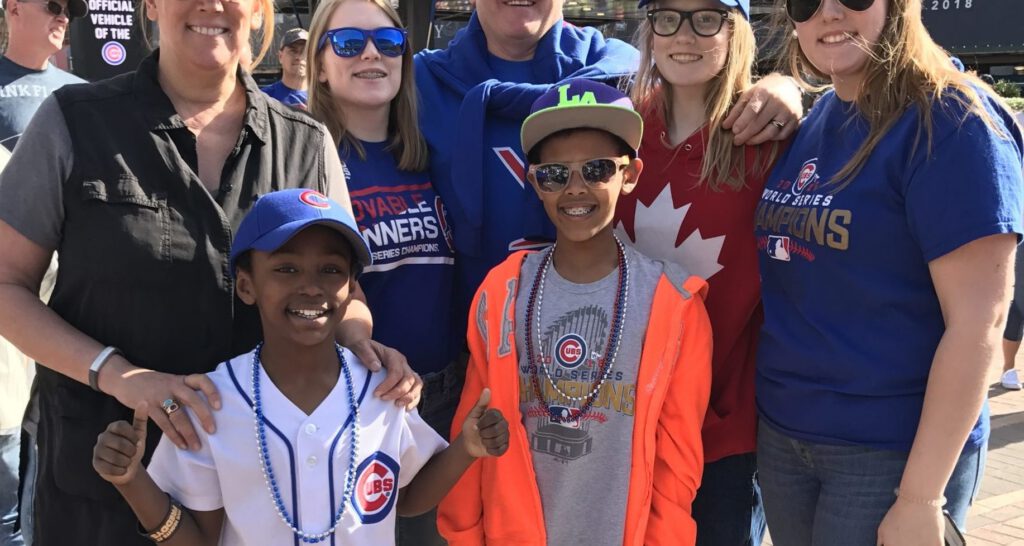

On the one-year anniversary of losing their son Gabriel, Carol and Brendan Deely launched Gabriel’s Light, a nonprofit organization with a mission to prevent youth suicide through mental health education that drives awareness and empowers action. They’re dedicated to sharing their family’s story to encourage others to confront mental health challenges head-on — and over the past six years, their mission has had a powerful impact.
“In a very short period of time, they have built an effective foundation that has reached nearly 100,000 individuals,” says Deborah R. Major, Director of Catholic Charities’ Loving Outreach to Survivors of Suicide (LOSS) Program.
For their advocacy, courage, and commitment to preventing youth suicide, the Deely family will receive the 2025 Charles T. Rubey LOSS Award during the April 27 Blossoms of Hope brunch.
“Their work is very inspiring,” Major says. “What they have chosen to do through their foundation transforms the meaning of traumatic loss and brings a transcendent purpose to life. When we see LOSS members go from feeling shattered to making the lives of others better, that is very inspiring.
“What inspires awe is this determination to reconstruct lives of meaning and purpose in the wake of the worst tragedy imaginable.”
Preventing youth suicide
The Deely family forever changed November 14, 2018, when they lost their 12-year-old son, Gabriel, to suicide. The next day, their family was connected with Father Charles T. Rubey and Catholic Charities’ LOSS Program for grief support.
The LOSS Program provides grief support to individuals and families who have lost a loved one to suicide. LOSS offers safe, nonjudgmental spaces where grievers can openly share their feelings and experiences about this traumatic loss. Since 1979, the program has served thousands of suicide loss survivors through support groups and individual counseling. Last year, approximately 350 people received grief support services through the LOSS Program.
“Everyone at the LOSS program is incredibly kind, caring, and supportive,” says Carol Deely. She shared that her family of six participated in group sessions and attended a one-day retreat. “They provided counseling for Brendan and me, our children, and our children’s friends who were at our home when the loss occurred. I honestly don’t know what we would have done without the LOSS program.”
Carol mentioned that discussing suicide had a significant impact on the family. They shared their feelings and explored how the loss affected them. Through participation in LOSS support groups, they found a sense of community, built strong relationships with other survivors, and received the guidance and support needed to transform their tragedy into hope. This experience led them to create Gabriel’s Light, a foundation of educators, therapists, and social workers who share Gabriel’s story while providing awareness and resources about suicide prevention.
Addressing trends around youth suicide
Every four days an Illinois teen takes their life, according to the Illinois Department of Public Health. The American Foundation for Suicide Prevention reports suicide ranks as a leading cause of death for children ages 10 to 19 — claiming more lives than any other major medical illness. The Centers for Disease Control and Prevention (CDC) also report there are more than 3,700 suicide attempts each day nationally by students in grades 9-12. Four out of five of these teens give some sign of their intentions.
The Gabriel’s Light team addresses these trends, visiting grade schools and high schools, afterschool programs, and summer day/overnight camps to educate children and adolescents in grades four to 12, as well as groups of teachers and parents. The foundation responds to anyone who calls, they never charge a fee, and their presentations have proven to help prevent youth suicide.
“Educating our 7th and 8th grade students that mental health is as important as physical health, and our 4th, 5th and6th graders about bullying — we simply could not have done it without you,” writes a Chicago Public School assistant principal in a thank-you note to Gabriel’s Light. “I just want you to know you are making a positive impact on our school community, and because of your kindness, we see the students being kinder to each other and more open about their emotions. We appreciate you. We are proud to partner with you. You are our angels.”
Increasing awareness, saving lives
After a Gabriel’s Light educator recently presented at an afterschool program on Chicago’s south side, a student approached them and expressed that they were feeling like they didn’t want to wake up or be alive. The student was immediately connected to resources, and both the school and the parents were notified.
“If we saved one life, that’s one significant life, but we know it’s many more than that,” Carol says. “The silver lining of the pandemic is people are more willing to talk about mental health. We try to normalize asking for help as a sign of strength, not a weakness.”
Gabriel’s Light educators encourage students to speak up and reach out to a trusted adult if they hear a classmate express feelings of worthlessness. They teach students to never joke about suicide. They emphasize the importance of sensitivity around the topic of suicide. Age-appropriate, hands-on activities teach younger children how to support themselves and friends in need. Recently, their team provided suicide prevention training to teachers at a school that experienced the tragic loss of an 8-year-old. Carol says teachers left the training feeling more informed about what to look for in a student who may be struggling.
A network of partners and ambassadors
“People think it’s too young, but it really isn’t,” Carol says. “It’s a myth that if you talk about suicide with kids, it encourages them to consider suicide. The more you talk about it, you’re helping them. If they’re suffering, they know there’s a safe person they can talk to. Kids hold it in, but once you open the door, they’ll speak up.”
Gabriel’s Light partners with Teen Mental Health First Aid, which has trained 250 youth ambassadors to intervene with their peers. In schools, the team distributes self-reporting slips to check in on students’ mental health during presentations and shares Gabriel’s story so students know it can happen to people their age and younger.
“We presented at a high school of 600 students, and 34 students asked for support,” Carol says. “One student was transported that day to the emergency room, others were referred to mental health services and parents were called so they could get the care they needed right away.”
Gabriel’s story
The Deelys adopted Gabriel from Ethiopia when he was four months old. Named after the patron saint of his native country, he was a gift to the family just days before Christmas in 2006. His older sisters — then ages 3, 4, and 6 — embraced the new member of their family.
“Gabe was always a very happy baby with a bright smile, silly, funny, he really made people laugh,” Carol says. “He was a huge source of joy for our family.”
The Deelys met his birth mother, a single teenage mom, and her parents, and visited the family in Ethiopia three times in Gabriel’s short life. They later adopted another boy from Ethiopia to join their family.
After their loss of Gabriel, the Deelys discovered that he had been using his school iPad to research suicide and different ways to end his life. They also learned that he had talked with classmates about suicide; he had drawn images of suicide and told his classmates a story about a sad, lonely boy. The girls in his class cried but didn’t know it was about him. Carol notes that these challenges were not apparent at home. However, if the school had implemented reliable internet safety software, which many schools now use, they would have received timely alerts and could have intervened effectively with Gabriel.
This proactive approach can truly make a difference, she says, adding: “Eighty percent of kids ages 8 to 20 communicate their suicide plans to a peer. Often, friends are asked to keep it confidential. We empower kids by teaching them that if someone expresses thoughts of suicide, they should confidently reach out to an adult for support and guidance.”
Carol says one of the most rewarding aspects of Gabriel’s Light is helping other families navigate the challenges of guilt and grief that survivors of suicide loss, like the Deely family, often experience. Gabriel’s Light has brought their family peace through service. She says they are proud that this legacy for Gabriel is making a difference in young lives.
Learn more at gabrielslight.org. Requests for presentations, and registration for a fundraising golf outing planned for July 21 at Harborside International Golf Center, Chicago, can be made at carol@gabrielslight.org
9-8-8, the Suicide and Crisis Lifeline, is a 24-hour, toll-free, confidential suicide prevention hotline available to anyone in suicidal crisis or emotional distress.